
If you’re planning to open a restaurant or cafeteria in Dubai, getting a restaurant mainland license Dubai authorities recognize is the first real decision you’ll make. For almost every other business type, mainland versus free zone is a genuine toss-up. For a dine-in restaurant or cafeteria, it isn’t. The overwhelming majority go mainland, and once you understand how food licensing actually works, it stops looking like a choice and starts looking like the only workable path.
Quick answer: Dine-in restaurants and cafeterias in Dubai need a mainland trade license from the Department of Economy and Tourism (DET), because free zone licenses don’t allow you to serve walk-in customers from the general public. On top of that, every food business, mainland or free zone, must separately pass Dubai Municipality Food Control Department approval on the physical premises before it can legally serve food.
Restaurant Mainland License Dubai: Why Free Zones Can’t Serve the Public
A free zone license lets you trade within that free zone, or internationally, but it doesn’t automatically give you the right to sell to walk-in customers across Dubai. A restaurant inside a free zone can usually only serve people who already work or live in that zone. The moment your concept depends on footfall from the general public (a street-facing café, a mall unit, a neighbourhood restaurant), a free zone license simply doesn’t cover it.
A mainland DET license is different. It lets you operate anywhere in the emirate, serve any customer, take reservations, cater off-site, and open multiple branches under one legal entity. For a business built around dine-in traffic, that’s not a nice-to-have. It’s the entire business model. You can review DET’s own licensing remit on the official Dubai Department of Economy and Tourism website.
Free zones still make sense for cloud kitchens, delivery-only concepts, food production, or catering companies with no public-facing premises. If no one is walking through a door to sit down and order, a free zone setup can work well and often costs less to start. But the moment you add seating and a “come on in” sign, you’re back to needing mainland.
Two Separate Approvals for Your Mainland Restaurant License in Dubai
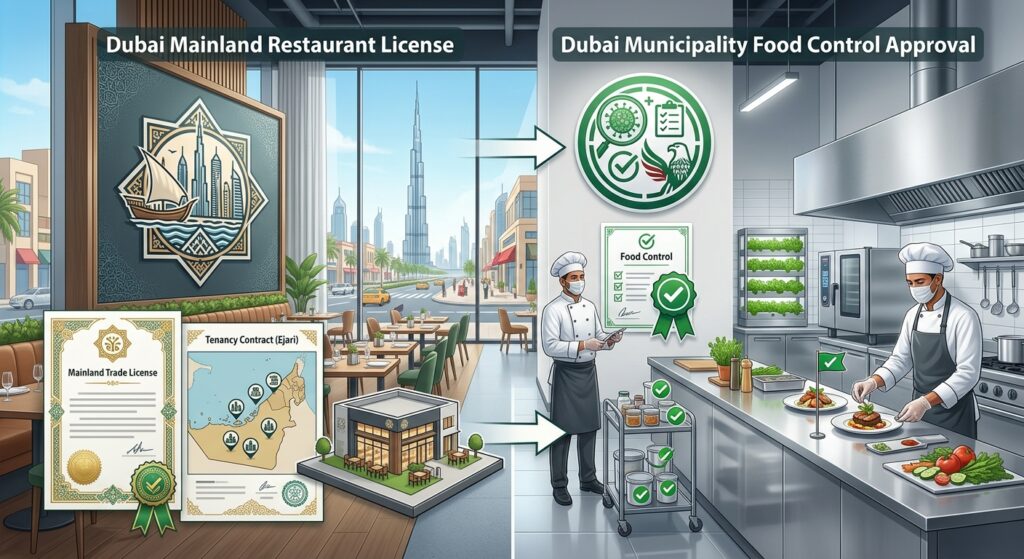
This is where a lot of first-time restaurant owners get caught out. Getting a trade license is only step one. A restaurant or cafeteria in Dubai needs sign-off from two different authorities before it can legally serve a single customer:
- DED / DET: approves the business activity itself (restaurant, cafeteria, quick-service, catering, etc.) and issues the commercial trade license.
- Dubai Municipality’s Food Control Department: approves the premises. This covers kitchen layout, ventilation, flooring and wall finishes, equipment placement, waste handling, and pest control arrangements, enforced through a physical site inspection, not just paperwork. Details on this process are published on the official Dubai Municipality website.
Both approvals are mandatory, and they’re sequential. Food Control won’t sign off on a location that doesn’t already have DED’s initial activity approval in place, and you can’t legally open without both. Miss this sequencing and you end up with a fitted-out space and a trade license, but no permission to actually serve food from it.
What Dubai Municipality Food Control Actually Checks
Food Control Department approval isn’t a rubber stamp. Typical requirements include:
- Kitchen and premises drawings submitted and approved before fit-out begins
- Easy-to-clean floor and ceiling finishes, proper ventilation, and separation between food prep and other areas
- A Person in Charge (PIC) who has completed Dubai Municipality-approved food safety training
- Valid health cards for all food handlers
- An active pest control contract with a licensed provider, with logs available for inspection
- A physical site inspection before the final food safety certificate is issued
The full cycle, from DED initial approval through fit-out, inspection, and final certification, typically takes 6 to 16 weeks, depending on how complete your documentation and drawings are the first time around. Businesses that design their kitchen to Food Control’s standards from day one move through this far faster than those that build first and try to get approved afterward.
Why a Mainland License Wins for Dine-In Concepts
Put the two requirements together and the logic becomes clear:
- Dine-in means serving the general public, so that needs a mainland trade license
- Serving food to the public at all, mainland or free zone, means Dubai Municipality Food Control approval on the premises
- A free zone license doesn’t remove the Food Control step. It just adds the problem of not being allowed to serve the customers you actually want
A mainland restaurant owner deals with one licensing authority (DET) plus one compliance authority (Food Control). A free zone restaurant owner deals with the free zone authority, still needs Food Control approval for the kitchen, and still can’t legally serve the public without additional mainland structuring. It’s more complexity for a more restricted business, which is exactly why Dubai’s dine-in and cafeteria market is overwhelmingly mainland.
Restaurant Mainland License Dubai: The Practical Takeaway
If your concept has seating, a storefront, or walk-in customers, plan for a mainland restaurant license from day one and start your Food Control documentation in parallel with your DED application, not after your lease is signed and your kitchen is built. Getting the sequencing right is the difference between opening on schedule and paying twice for a fit-out.
Explore Bizgate’s Restaurant and Cafeteria Setup service or our Food Stuff Trading License guide for the next steps, or start your mainland company formation directly.
FAQs: Restaurant Mainland License in Dubai
Can a free zone company open a dine-in restaurant in Dubai?
Not for the general public. A free zone license only allows you to serve customers within that free zone. A dine-in restaurant serving walk-in customers across Dubai needs a mainland DET trade license.
Do I need Dubai Municipality approval even with a mainland license?
Yes. Every food business, mainland or free zone, must pass Dubai Municipality Food Control Department approval on the physical premises, in addition to the DED/DET trade license.
How long does it take to open a restaurant in Dubai?
From DED initial approval through fit-out, Food Control inspection, and final certification, the process typically takes 6 to 16 weeks, depending on how complete your documentation and premises drawings are from the start.
Is a free zone license ever a good option for F&B?
Yes, for cloud kitchens, delivery-only concepts, food production, or catering businesses with no public-facing premises. Dine-in and walk-in retail specifically require a mainland license.